
26. Domain propagation
The propagators in previous chapters use simple modification operations on variable views in that only a single integer defines how a view’s domain is changed. When programming propagators that perform more elaborate domain reasoning, these modification operations are typically insufficient as they easily lead to incorrect and inefficient propagators.
To conveniently program efficient propagators that perform domain reasoning, Gecode offers modification operations that take entire sets of integers as arguments. To be efficient, these sets are not implemented as a typical set data structure but as iterators: the integers (or entire ranges of integers) can be iterated in increasing order (smallest first).
Overview. This chapters motivates why special domain operations on variable views are needed (Why domain operations are needed) and demonstrates how iterators are used for domain propagation (Iterator-based modification operations and Taking advantage of iterators). Modification event deltas and Staging describe modification event deltas and staging for efficiently combining bounds with domain propagation.
26.1. Why domain operations are needed
...
class Equal : public BinaryPropagator<Int::IntView,Int::PC_INT_DOM> {
public:
  Equal(Home home, Int::IntView x0, Int::IntView x1)
    : BinaryPropagator<Int::IntView,Int::PC_INT_DOM>(home,x0,x1) {}
  ...
  virtual ExecStatus propagate(Space& home, const ModEventDelta&) {
    Int::ViewValues<Int::IntView> i(x0), j(x1);
    while (i() && j())
      if (i.val() < j.val()) {
        GECODE_ME_CHECK(x1.nq(home,i.val())); ++i;
      } else if (j.val() < i.val()) {
        GECODE_ME_CHECK(x0.nq(home,j.val())); ++j;
      } else {
        ++i; ++j;
      }
    while (i()) {
      GECODE_ME_CHECK(x1.nq(home,i.val())); ++i;
    }
    while (j()) {
      GECODE_ME_CHECK(x0.nq(home,j.val())); ++j;
    }
    if (x0.assigned() && x1.assigned())
      return home.ES_SUBSUMED(*this);
    else
      return ES_FIX;
  }
};

...
Let us consider an attempt to implement domain propagation for an equality constraint on views x0 and x1. The idea for pruning is simple: only keep those values of x0 and x1 that are common to the domains of both x0 and x1. This leads to a first version of a domain equality propagator as shown in Program 26.1. Beware, the “propagator” is not only naive but also incorrect: it will crash Gecode!
The propagator uses iterators of type Int::ViewValues to iterate over the values of an integer view in increasing order (the template argument defines the type of the view to iterate on). The increment operator ++ moves the iterator to the next value, the application operator () tests whether the iterator has more values to iterate, and the function val() returns the iterator’s current value. The reason why the propagator will crash is simple: it uses the iterator i for iterating over the values of x0 and modifies the domain of x0 while iterating! This is illegal: when using an iterator for a view, the view cannot be modified (or, in C++ lingua: modifying the variable invalidates the iterator).
One idea how to fix this problem is to use a temporary data structure in which the newly computed intersection domain is stored. That is not very tempting: allocating and initializing an intermediate data structure is costly.
But even then, the approach is flawed from the beginning: a single nq() operation on a view has linear runtime in the size of the view’s domain (actually, in the length of its range sequence, see below). As potentially a linear number of nq() operations are executed, the propagator will have quadratic complexity even though it should have linear (as the values of the domains are available in strictly increasing order).
26.2. Iterator-based modification operations
...
class Equal : public BinaryPropagator<Int::IntView,Int::PC_INT_DOM> {
...
  virtual PropCost cost(const Space&, const ModEventDelta&) const {
    return PropCost::binary(PropCost::HI);
  }
  virtual ExecStatus propagate(Space& home, const ModEventDelta&) {
    Int::ViewRanges<Int::IntView> r0(x0);
    GECODE_ME_CHECK(x1.inter_r(home,r0));
    Int::ViewRanges<Int::IntView> r1(x1);
    GECODE_ME_CHECK(x0.narrow_r(home,r1));
    if (x0.assigned() && x1.assigned())
      return home.ES_SUBSUMED(*this);
    else
      return ES_FIX;
  }
};

...
Download: naive-domain-equal.cpp
Program 26.2 shows a working, yet still naive, implementation of an equality propagator performing domain reasoning. Note that the cost() function is overridden: even though the propagator is binary, it now incurs a higher cost due to the domain operations to be performed. The propagate() function uses two range iterators for iterating over the range sequence of the domains of x0 and x1. For the definition of a range sequence, see Iterating over integer variable domains.
A range iterator for a range sequence \(s=\left\langle [n_i..m_i]\right\rangle_{i=0}^{k}\) is an object that provides iteration over \(s\): each of the \(\left[m_i\;..\;n_i\right]\) can be obtained in sequential order but only one at a time. A range iterator provides the following operations: the application operator () tests whether there are more ranges to iterate, the increment operator ++ moves to the next range, the function min() (max()) returns the smallest (largest) value of the current range, and the function width() returns the width of the current range (that is, its number of elements) as an unsigned integer.
The motivation to iterate over range sequences rather than individual values is efficiency: as there are typically less ranges than indvidual values, iteration over ranges can be more efficient. Moreover, many operations are sufficiently easy to express in terms of ranges rather than values (see Taking advantage of iterators for an example).
Iterator-based modification operations. The propagator uses two modification operations for range iterators: x1.inter_r() intersects the current domain of x1 with the set defined by the range iterator r0 for x0. After this operation (provided no failure occurred), the view x1 has the correct domain: the intersection of the domains of x0 and x1. The operation x0.narrow_r() replaces the current domain of x0 by the set defined by the range iterator r1 (which iterates the intersection of the domains of x0 and x1).
A third operation available for range iterators is minus_r() which removes the values as described by the range iterator passed as argument.
Instead of using range iterators for modification operations, one can also use value iterators instead. Similarly, a view provides operations inter_v(), narrow_v(), and minus_v() for intersecting, replacing, and removing values.
Avoiding shared iterators. The problem that made our attempt to implement propagation for equality in Why domain operations are needed incorrect is to use iterators for iterating over views that are simultaneously modified.
Iterator-based modification operations automatically take care of potential sharing between the iterator they use and the view domain they update. By default, an iterator-based modification operation assumes that iterator and domain are shared. The operation first constructs a new domain and iterates to the end of the iterator. Only then the old domain is replaced by the newly constructed domain. In many cases, however, there is no sharing between iterator and domain and the operations could be performed more efficiently by in-place update operations on the domain.
Download: non-shared-domain-equal.cpp
In our example, there is no sharing if the views x0 and x1 do not refer to the very same variable implementation. If they do, the propagator should not even be posted as it is subsumed anyway (views of the same type referring to the same variable implementation are trivially equal). Program 26.3 shows the propagator post function of an improved propagator for equality: the propagator is posted only if x0 and x1 do not refer to the same variable implementation. The propagate() function is improved by giving an additional false argument to both inter_r() and narrow_r(). Hence, the two operations use more efficient operations performing in-place updates on domains.
26.3. Taking advantage of iterators
This section shows how the combination of simple iterators can help in implementing domain propagation.
Suppose that we want to implement a close variant of the equality constraint, namely \(x=y+c\) for integer variables \(x\) and \(y\) and some integer value \(c\). It is easy to see that the new domain for \(x\) must be all values of \(x\) intersected with the values \(\{n+c\mid n\in y\}\). Likewise, the new domain for \(y\) must be all values of \(y\) intersected with the values \(\{n-c\mid n\in x\}\). But how can we implement these simple propagation rules?
Mapping range sequences. Assume a range sequence \(\left\langle \left[m_i\;..\;n_i\right]\right\rangle_{i=0}^{k}\) for the values in the domain of \(y\). Then, what we want to compute is a range sequence
With other words, we want to map the first into the second range sequence. Luckily, this is easy. Suppose that r is a range iterator for the view y. A range iterator for our desired range sequence can be constructed using the Iter::Range::Map iterator and an object that describes how to map the ranges of r to the desired ranges.
For this, we define the following class:
class OffsetMap {
protected:
  int o;
public:
  OffsetMap(int o0) : o(o0) {}
  int min(int m) const {
    return m+o;
  }
  int max(int m) const {
    return m+o;
  }
};
OffsetMap defines to which values the minimum (min()) and the maximum (max()) of each input range must be mapped. Using OffsetMap, we can construct a range iterator m for our desired sequence by
OffsetMap om(c);
Iter::Ranges::Map<Int::ViewRanges<Int::IntView>,
                  OffsetMap> m(r,om);
...
// [domain equal with offset:offset map]
class EqualOffset :
  public BinaryPropagator<Int::IntView,Int::PC_INT_DOM> {
protected:
  int c;
...
  virtual ExecStatus propagate(Space& home, const ModEventDelta&) {
    Int::ViewRanges<Int::IntView> r0(x0);
    OffsetMap om0(-c);
    Iter::Ranges::Map<Int::ViewRanges<Int::IntView>,OffsetMap>
      mr0(r0,om0);
    GECODE_ME_CHECK(x1.inter_r(home,mr0,false));
    Int::ViewRanges<Int::IntView> r1(x1);
    OffsetMap om1(c);
    Iter::Ranges::Map<Int::ViewRanges<Int::IntView>,OffsetMap>
      mr1(r1,om1);
    GECODE_ME_CHECK(x0.narrow_r(home,mr1,false));
    ...
  }
};

...
Download: domain-equal-with-offset.cpp
With the help of the map range iterator, propagation for OffsetEqual as shown in Program 26.4 is straightforward. Note that several functions need to be modified to deal with the additional integer constant c used by the propagator (the details can be inspected by downloading the full program code). Further note that the constraint post function is slightly to liberal in that it does not check whether the values with the integer constant c added exceed the limits for legal integer values.
While the propagator is reasonably easy to construct using map iterators, Offset views shows how to obtain exactly the same propagator without any programming effort but the implementation of an additional constraint post function.
Using and defining iterators. Gecode comes with a multitude of range and value iterators to transform range and value sequences of other iterators. These iterators are defined in the namespace Iter. Range iterators are defined in the namespace Iter::Ranges and value iterators in the namespace Iter::Values. Example iterators include: iterators to convert value into range iterators and vice versa, iterators to compute the union and intersection, iterators to iterate over arrays and bitsets, just to name a few.
But even if the predefined iterators are not sufficient, it is straightforward to implement new iterators: the only requirement is that they implement the appropriate interface mentioned above for range or value iterators. The namespace Iter contains a multitude of simple and advanced examples.
Benefits of iterators. The true benefit of using iterators for performing value or range transformations is that the iterator-based domain modification operation with which an iterator is used is automatically specialized at compile time. Typically, no intermediate data structures are created and the modification operations are optimized at compile time for each individual iterator. [1]
A scenario where this in particular matters is when iterators are used as adaptors of a propagator-specific data structure. Assume that a propagator uses a specific (typically, quite involved) data structure to perform propagation. Most often this data structure encodes in some form which views should take which values. Then, one can implement simple iterators that inspect the propagator-specific data structure and provide the information about values for views so that they can be used directly with iterator-based modification operations. Again, intermediate data structures are avoided by this approach.
26.4. Modification event deltas
There is a rather obvious approach to improving the efficiency of domain operations performed by propagators: make the domains as small as possible! One typical approach to reduce the size of the domains is to perform bounds propagation first. After bounds propagation, the domains are likely to be smaller and hence the domain operations are likely to be more efficient.
For propagating equality, the simplest idea is to first perform bounds propagation for equality as discussed in Fixpoint reasoning reconsidered, directly followed by domain propagation. However, we can improve further by exploiting an additional token of information about the views of a propagator that is supplied to both the cost() and propagate() function of a propagator.
The cost() and propagate() functions of a propagator take an additional modification event delta value of type ModEventDelta (see Programming actors) as argument. Every propagator maintains a modification event delta that describes how its views have changed since the last time the propagator has been executed. For each view type (that is, integer, Boolean, set, \(\ldots\)) a modification event delta stores a modification event that can be extracted from the modification event delta: If med is a modification event delta, then Int::IntView::me(med) returns the modification event for integer views.
The extracted modification event describes how all views of a certain view type have changed. For example, for integer views, the modification event Int::ME_INT_VAL signals that there is at least one integer view that has been assigned since the propagator has been executed last (analogous for Int::ME_INT_BND and Int::ME_INT_DOM). Even the modification event Int::ME_INT_NONE carries some information: none of the propagator’s integer views have been modified (which, of course, can only happen if the propagator also uses views of some other type).
...
class Equal : public BinaryPropagator<Int::IntView,Int::PC_INT_DOM> {
...
  virtual ExecStatus propagate(Space& home,
                               const ModEventDelta& med) {
    if (Int::IntView::me(med) != Int::ME_INT_DOM) {
      do {
        GECODE_ME_CHECK(x0.gq(home,x1.min()));
        GECODE_ME_CHECK(x1.gq(home,x0.min()));
      } while (x0.min() != x1.min());
      do {
        GECODE_ME_CHECK(x0.lq(home,x1.max()));
        GECODE_ME_CHECK(x1.lq(home,x0.max()));
      } while (x0.max() != x1.max());
      if (x0.assigned() && x1.assigned())
        return home.ES_SUBSUMED(*this);
      if (x0.range() && x1.range())
        return ES_FIX;
    }
    ...
  }
};

...
Download: domain-equal-using-bounds-propagation.cpp
Program 26.5 shows a propagator that combines both bounds and domain propagation for propagating equality. It first extracts the modification event for integer views from the modification event delta med. Only if the bounds (that is, modification events Int::ME_INT_VAL or Int::ME_INT_BND, hence different from Int::ME_INT_DOM) have changed for at least one of the views x0 and x1, the propagator performs bounds propagation.
After performing bounds propagation, the propagator checks whether it is subsumed. Then it does some more fixpoint reasoning: if the domains of x0 and x1 are ranges (that is, they do not have holes), the propagator is at fixpoint. Otherwise, domain propagation is done as shown before.
26.5. Staging
Taking the perspective of a single propagator, first performing bounds propagation directly followed by domain propagation seems to be appropriate. However, when taking into account that some other cheap propagators (at least cheaper than performing domain propagation by this propagator) might already be able to take advantage of the results of bounds propagation, it might actually be better to postpone domain propagation and give cheaper propagators the opportunity to execute. This idea is known as staging and has been introduced in Gecode [51]. Note that staging is not limited to bounds and domain propagation but captures any stages in propagation that differ in cost.
Here, we focus on staging for first performing bounds propagation (stage “bounds”) and then domain propagation (stage “domain”) for equality. Additionally, a propagator can be idle (stage “idle”). The stage of a propagator is controlled by how its modification event delta changes:
Initially, the propagator is idle, its modification event delta is empty, and the propagator is in stage “idle”.
When the modification event delta for integer views changes to
Int::ME_INT_DOMand the propagator is in stage “idle”, the propagator is put into stage “domain” with high propagation cost.When the modification event delta for integer views changes to
Int::ME_INT_VALorInt::ME_INT_BND, the propagator is put into stage “bounds” with low propagation cost.Note that this in particular includes the case where the modification event delta for integer views has been
Int::ME_INT_DOMand where the propagator had already been in stage “domain”. As soon as the modification event delta changes toInt::ME_INT_BNDorInt::ME_INT_VALthe propagator is put into stage “bounds”.
By the very construction of modification event deltas, the modification event delta for integer views can neither change from Int::ME_INT_VAL to Int::ME_INT_BND nor from Int::ME_INT_BND (or Int::ME_INT_VAL) to Int::ME_INT_DOM. That is, if the equality propagator using staging is in stage “bounds” it stays in that stage until it is executed.
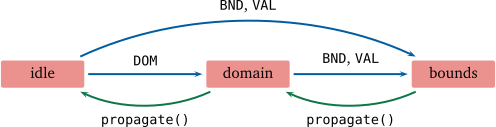
Figure 26.1 Stage transitions for the equality propagator
When the propagator is executed, it can be either in stage “bounds” or stage “domain”. If it is executed in stage “bounds”, it performs bounds propagation and then returns that it wants to be put into stage “domain”. The essential point is that the propagator does not continue with domain propagation but gives other propagators the opportunity to execute first. If the propagator is executed in stage “domain”, it performs domain propagation and returns that it is at fixpoint (and hence the propagator is put into stage “idle”). Figure 26.1 summarizes the stage transitions, where a blue transition is triggered by a change in the modification event delta (Int::ME_INT_DOM is abbreviated by DOM and so on) and a green transition is performed be executing the propagator.
Re-scheduling propagators. The cost of a propagator depends on its modification event delta. This connection goes even further: only if the modification event delta of a propagator changes, a propagator is re-scheduled according to its cost by recomputing the cost() function.
Not recomputing cost each time a propagator might be scheduled is done for two reasons. First, the number of possibly expensive cost computations is reduced. Second, always re-scheduling would also violate the fairness among all propagators already scheduled with same cost. If a propagator is scheduled often, it would be penalized as its execution would be deferred.
Forced propagator re-scheduling discusses a technique to force re-scheduling of a propagator, irrespective of its modification event delta.
Controlling staging by modification event deltas.
...
class Equal : public BinaryPropagator<Int::IntView,Int::PC_INT_DOM> {
...
  virtual PropCost cost(const Space&,
                        const ModEventDelta& med) const {
    if (Int::IntView::me(med) != Int::ME_INT_DOM)
      return PropCost::binary(PropCost::LO);
    else
      return PropCost::binary(PropCost::HI);
  }
  virtual ExecStatus propagate(Space& home,
                               const ModEventDelta& med) {
    if (Int::IntView::me(med) != Int::ME_INT_DOM) {
      ...
      return home.ES_FIX_PARTIAL
        (*this,Int::IntView::med(Int::ME_INT_DOM));
    }
    ...
  }
};

...
Download: domain-equal-using-staging.cpp
The cost() function and the essential parts of the propagate() function of a propagator that uses staging to combine bounds and domain propagation for equality are shown in Program 26.6.
The cost() function returns the cost based on the modification event delta med: if med only includes Int::ME_INT_DOM, then the propagator returns that next time it executes, it executes at high-binary cost (according to stage “domain”). Otherwise, the propagator returns that next time it executes, it executes at low-binary cost (according to stage “bounds”).
The propagate() function is almost identical to the function shown in the previous section. The only difference is that propagate() returns after having performed bounds propagation. The call to ES_FIX_PARTIAL() specifies that the current propagator *this has computed a partial fixpoint for all modification events but Int::ME_INT_DOM. The function Int::IntView::med creates a modification event delta from a modification event for integer views. As an effect, the modification event delta of the current propagator is set to include nothing but Int::ME_INT_DOM and the propagator is scheduled: as defined by the cost() function, the propagator is scheduled for high binary cost. That means that other propagators of lower cost might be executed first.
Constructing modification event deltas. Every view type provides a static med() function that translates a modification event of that view type into a modification event delta. Modification event deltas for different view types can be combined with the | operator. For example, the following expression combines the modification event ME_INT_BND for integer views with the modification event ME_BOOL_VAL for Boolean views:
Int::IntView::med(ME_INT_BND) | Int::BoolView::med(ME_BOOL_VAL)
Note that only modification event deltas for different view types can be combined using |.