
19. Knight’s tour
This chapter demonstrates a problem-specific brancher inspired by a classic heuristic for a classic problem.
Important
This case study requires knowledge on programming branchers, see Programming branchers .
19.1. Problem
The problem of a knight’s tour is to find a series of knight’s moves (a knight can move two fields vertically and simultaneously one field horizontally, or vice versa) on an empty \(n\times n\) board starting from some initial field such that:
each field is visited exactly once, and
there is a further knight’s move from the last field of the tour to the initial field.
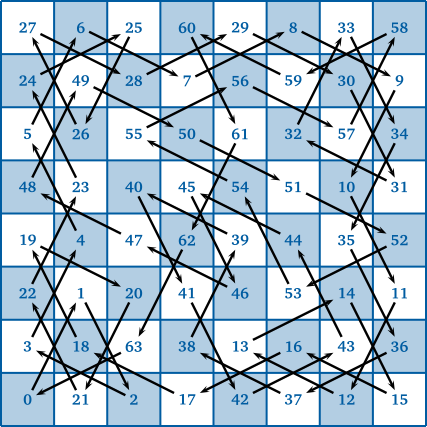
Figure 19.1 \(8\times 8\)-knight’s tour
Figure 19.1 shows a knight’s tour for \(n=8\), where the tour starts at the lower left corner.
19.2. Model
The model for the knight’s tour uses a successor representation for the knight’s moves to make posting the constraints straightforward. To further simplify posting the constraints, the variables in the model use fields on the board as values. The field \(0\) has \(\langle \mathtt x,\mathtt
y\rangle\)-coordinates \(\langle 0,0\rangle\) on the board, the field \(1\) has coordinates \(\langle 1,0\rangle\), the field \(n\) on an \(n\times n\) board has coordinates \(\langle 0,1\rangle\), and so on. That is, fields on the board are counted first in x-direction and then in y-direction.
The successor representation means that a variable in the model has the field numbers as possible values that can be reached by a knight’s move. The model uses the circuit constraint (see Circuit and Hamiltonian path constraints ) to enforce that the tour is in fact a Hamiltonian circuit. The only additional constraints needed are that fields must be reachable only by knight’s moves.
#include <climits>
...
// [knights:brancher]
class Knights : public Script {
protected:
  const int n;
  IntVarArray succ;
public:
  int f(int x, int y) const { return x + y*n; }
  ...
  IntSet neighbors(int i) {
    ...
  }
  Knights(const SizeOptions& opt)
    : Script(opt), n(opt.size()), succ(*this,n*n,0,n*n-1) {
   // [knights:knight's moves]
    // [knights:fix first move]
    // [knights:Hamiltonian circuit]
    warnsdorff(*this, succ);
  }
  ...
};

...
Download: knights.cpp
A script for the knight’s tour problem outlines the program to implement the knight’s tour model. An object of class Knights stores the size of the board as its member n. The variables for the knight moves are stored in the integer variable array (see Integer and Boolean variable arrays ) succ. The array succ has \(\mathtt{n}^2\) elements where the variable at position f stores the successor of the field f. The function f(x,y) computes the field number for coordinates \(\langle\mathtt x,\mathtt
y\rangle\). For example, f(0,0)=0, f(1,0)=1, and f(0,1)=n.
19.2.1. Enforcing knight’s moves.
Domain constraints dom (see Domain constraints ) are used to constrain moves to knight’s moves:
    for (int i=0; i<n*n; i++)
      dom(*this, succ[i], neighbors(i));
The function neighbors(i) returns an integer set which contains the fields that are reachable from field i by a knight’s move. For example, for \(\mathtt{n}=8\), neighbors(0) (the field 0 has coordinates \(\langle\mathtt{0},\mathtt{0}\rangle\)) returns the integer set \(\{\mathtt{17},\mathtt{10}\}\) (that is, the fields with coordinates \(\langle\mathtt{2},\mathtt{1}\rangle\) and \(\langle\mathtt{1},\mathtt{2}\rangle\)) and neighbors(27) (the field 27 has coordinates \(\langle\mathtt{3},\mathtt{3}\rangle\)) returns the integer set \(\{\mathtt{17},\mathtt{33},\mathtt{10},\mathtt{42},\mathtt{12},\mathtt{44},\mathtt{21},\mathtt{37}\}\) (that is, the fields with coordinates \(\langle\mathtt{2},\mathtt{1}\rangle\), \(\langle\mathtt{4},\mathtt{1}\rangle\), \(\langle\mathtt{1},\mathtt{2}\rangle\), \(\langle\mathtt{5},\mathtt{2}\rangle\), \(\langle\mathtt{1},\mathtt{4}\rangle\), \(\langle\mathtt{5},\mathtt{4}\rangle\), \(\langle\mathtt{2},\mathtt{5}\rangle\), and \(\langle\mathtt{4},\mathtt{5}\rangle\)).
19.2.2. Fixing the first move.
Without loss of generality we fix that the knight’s first move goes to field f(1,2):
rel(*this, succ[0], IRT_EQ, f(1,2));
Fixing the first move can be seen as breaking a symmetry in the model and hence reduces the amount of search needed for finding a knight’s tour.
19.2.3. Enforcing a Hamiltonian circuit.
The circuit constraint (see Circuit and Hamiltonian path constraints ) enforces that the tour of knight’s moves forms a Hamiltonian circuit:
circuit(*this, succ, IPL_DOM);
We request domain propagation for the circuit constraint by providing IPL_DOM as argument (see Selecting the propagation level ). (Of course, domain propagation for circuit does not achieve domain consistency, as the problem of finding Hamiltonian circuits is NP-complete (p. 199; [16]) .) Intuitively, we want to have the strongest possible propagation available for circuit as it is the only constraint.
19.3. Branching
The really interesting aspect of solving the knight’s tour puzzle is to find a branching that works well. A classic approach is Warnsdorff’s heuristic [67] : move the knight to a field that has the least number of further possible moves.
In terms of our model, Warnsdorff’s heuristic has of course no procedural notion of moving the knight! Instead, our branching finds a yet unassigned field \(i\) on the board (a field whose successor is not known yet). Then, it first tries a value for \(\mathtt{succ}_i\) that moves the knight to a field with the least number of further possible moves. That is, the branching first tries a value n for \(\mathtt{succ}_i\) such that the domain size of \(\mathtt{succ}_\mathtt{n}\) is smallest. If there are several such values, it just tries the smallest first (as it is most natural to implement).
19.3.1. The brancher.
class Warnsdorff : public Brancher {
protected:
  ViewArray<Int::IntView> x;
  mutable int start;
  class PosVal : public Choice {
  ...
  };
public:
  ...
  // [knights:status function]
  // [knights:choice function]
  ...
};

void warnsdorff(Home home, const IntVarArgs& x) {
  ...
}
The brancher. shows an outline of a branching and a brancher implementing Warnsdorff’s heuristic. The members of Warnsdorff are exactly the same as for the example brancher in Improving status and choice : the view array x stores the knight’s moves, the mutable integer start points to the current unassigned view in x, and the PosVal choice stores the position of the view and the value to be used for branching.
19.3.2. Status computation.
The status() function tries to find a yet unassigned view for branching in the view array x. It starts inspecting the views from position start. If it finds an assigned view, it moves start to the position in the view array as defined by the assigned view’s value. In other words, status() follows partially constructed knight’s tours. If status() finds an unassigned view, it returns true:
  virtual bool status(const Space&) const {
    for (int n=0; n<x.size(); n++) {
      if (!x[start].assigned())
        return true;
      start = x[start].val();
    }
    return false;
  }
The number of attempts to find an unassigned view is limited by the number of views in the view array x. If the limit is exceeded, all views are assigned and hence the status() function returns false.
19.3.3. Choice computation.
The choice() function implements the actual heuristic. It chooses the value of x[start] for branching that has the smallest domain size as follows:
  virtual Choice* choice(Space&) {
    int n=-1; unsigned int size=UINT_MAX;
    for (Int::ViewValues<Int::IntView> i(x[start]); i(); ++i)
      if (x[i.val()].size() < size) {
        n=i.val(); size=x[n].size();
      }
    return new PosVal(*this,start,n);
  }
As mentioned above, to keep the implementation simple, if there are several values that have smallest domain size, the first is chosen (and hence the smallest).
Note that the value UINT_MAX is larger than the size of any view domain. (UINT_MAX (for the maximal value of an unsigned integer) is available as the program includes the header file.) Hence, it is guaranteed that the for-loop will always choose a value from the domain of x[start]. The choice returned is the typical implementation to store position and value, similar to the examples in Improving status and choice .
19.4. More information
The model is also available as a Gecode example, see knights:KnightsCircuit . The Gecode example also features a simple standard branching that can be compared to Warnsdorff’s branching and a naive model using reification instead of circuit (see knights:KnightsReified ).